

Seed Grant Project · Scholarly Edition
A Hyperlinked Edition of the Huainanzi
More than a third of the Huainanzi is woven from pre-Han writings. This edition makes that weave visible — chapter by chapter, parallel by parallel.
- Laozi
- Zhuangzi
- Lüshi chunqiu
- Guanzi
- original to Liu An’s court
A passage, colour-coded
The Way covers heaven and supports earth, spreads across the four quarters, opens out to the eight limits; too high to reach, too deep to fathom — it wraps heaven and earth and gives form to the formless.
- Laozi
- Zhuangzi
- Lüshi chunqiu
- Guanzi
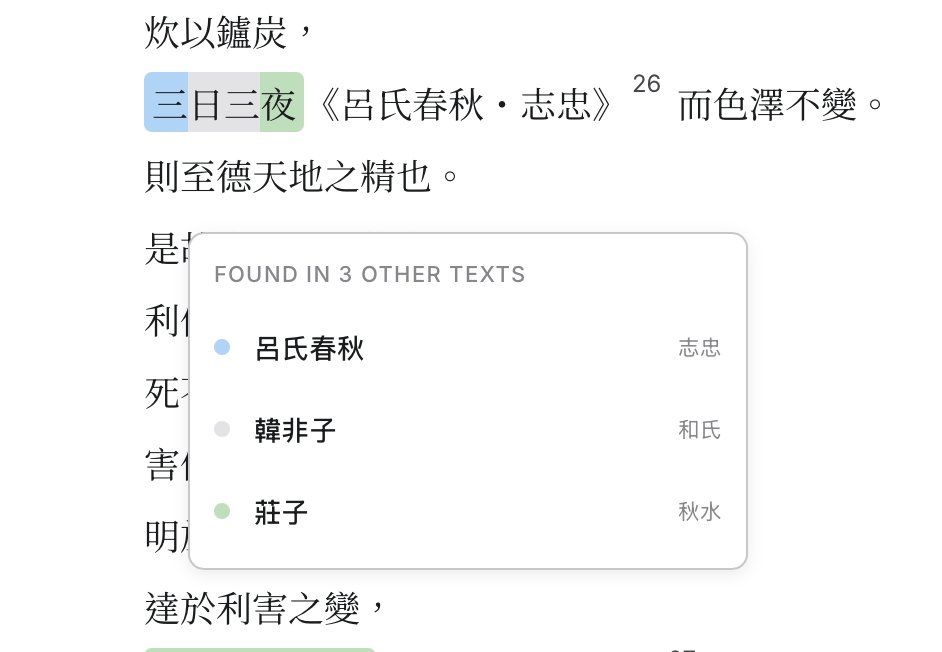
Each coloured run comes from a different pre-Han writing; in the hyperlinked edition, clicking a passage opens every candidate source.
Plates
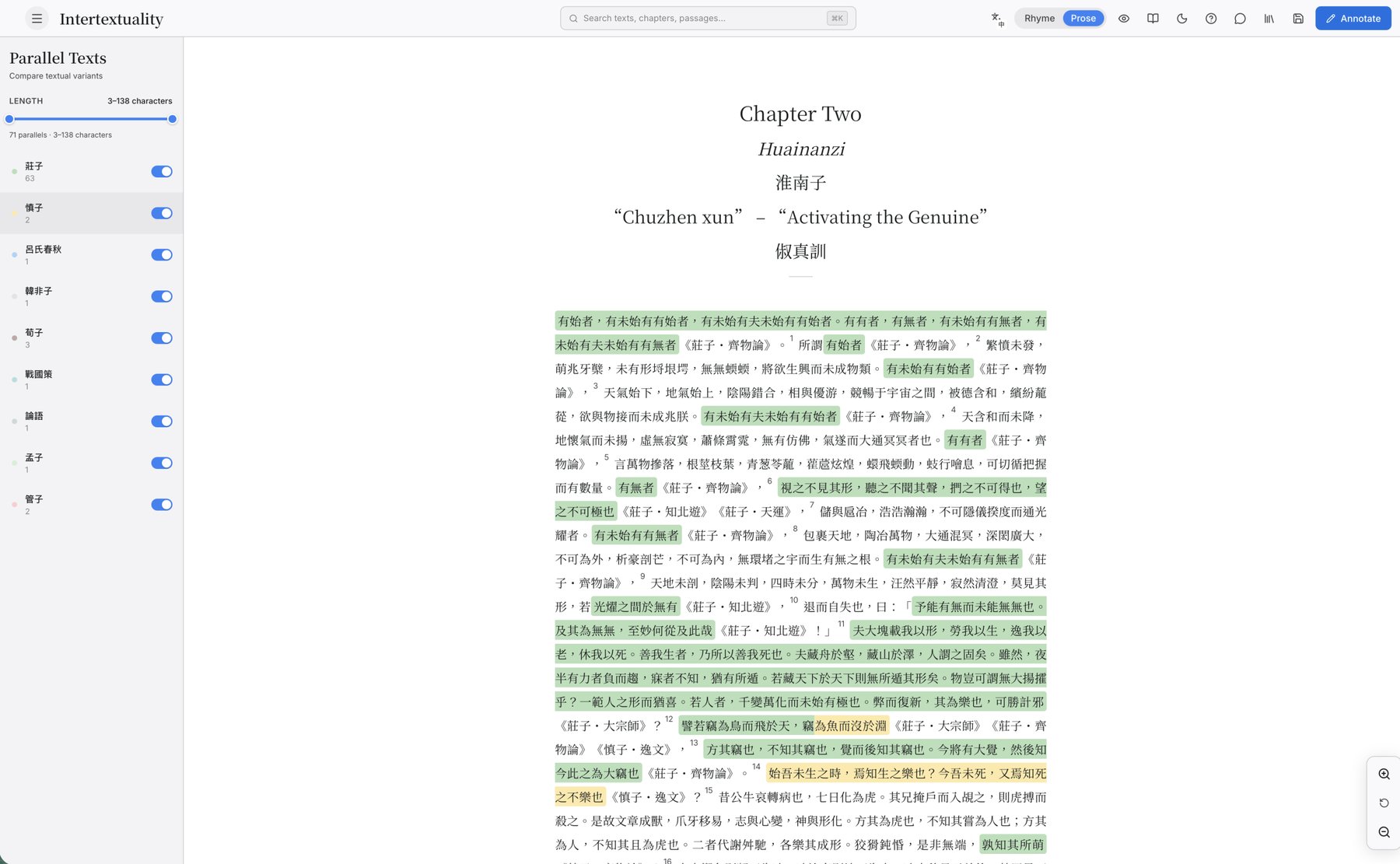
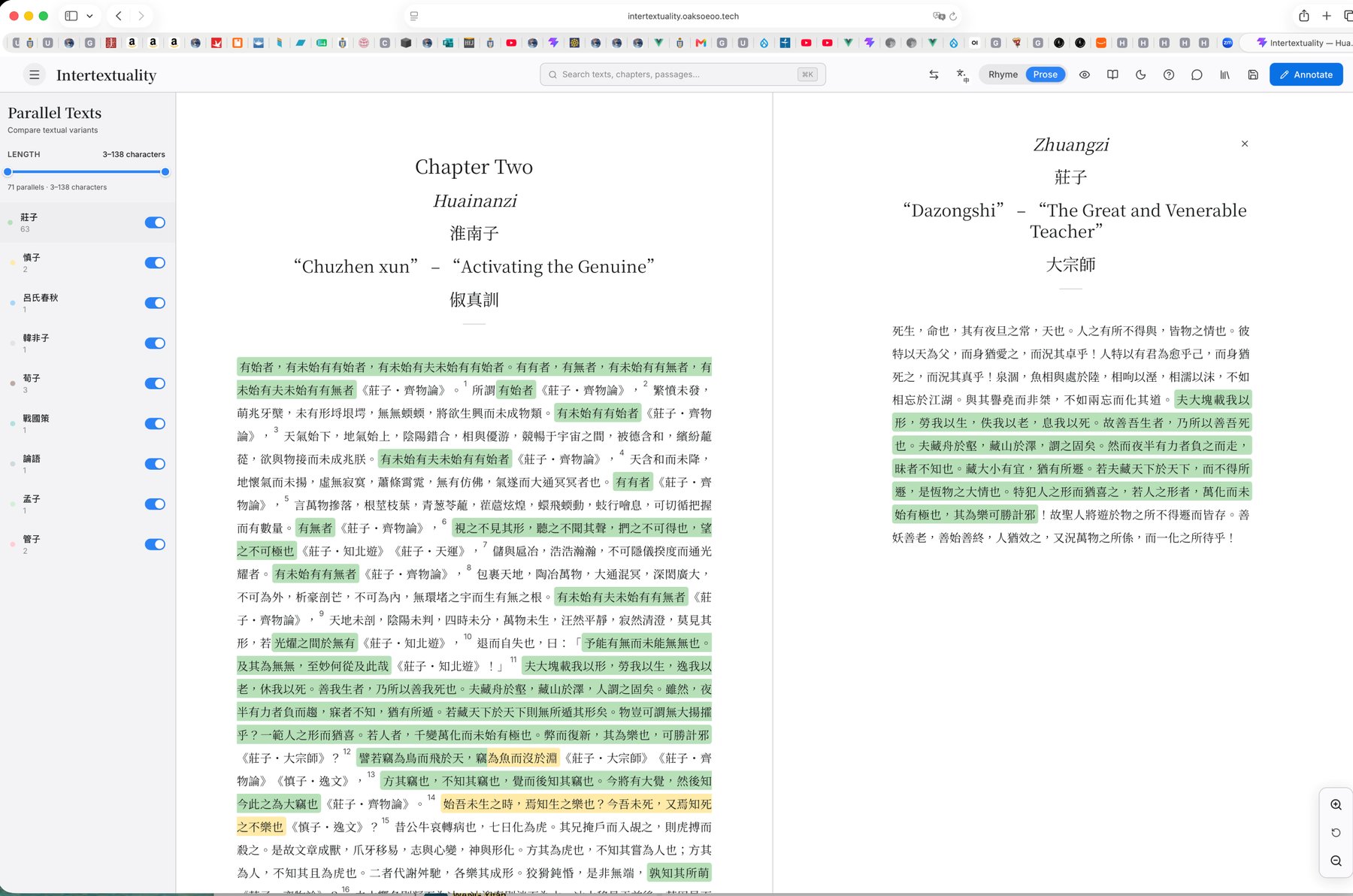
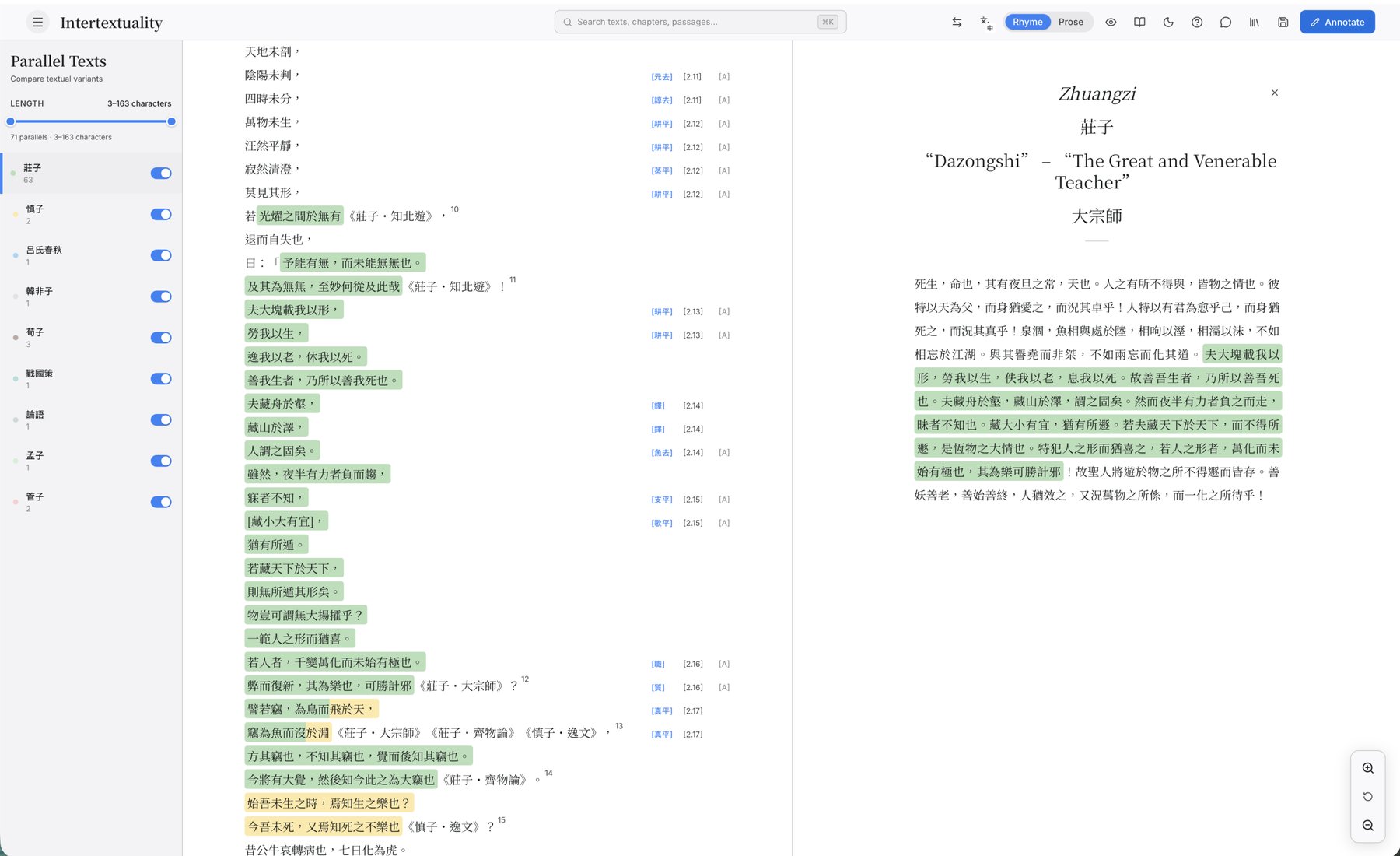
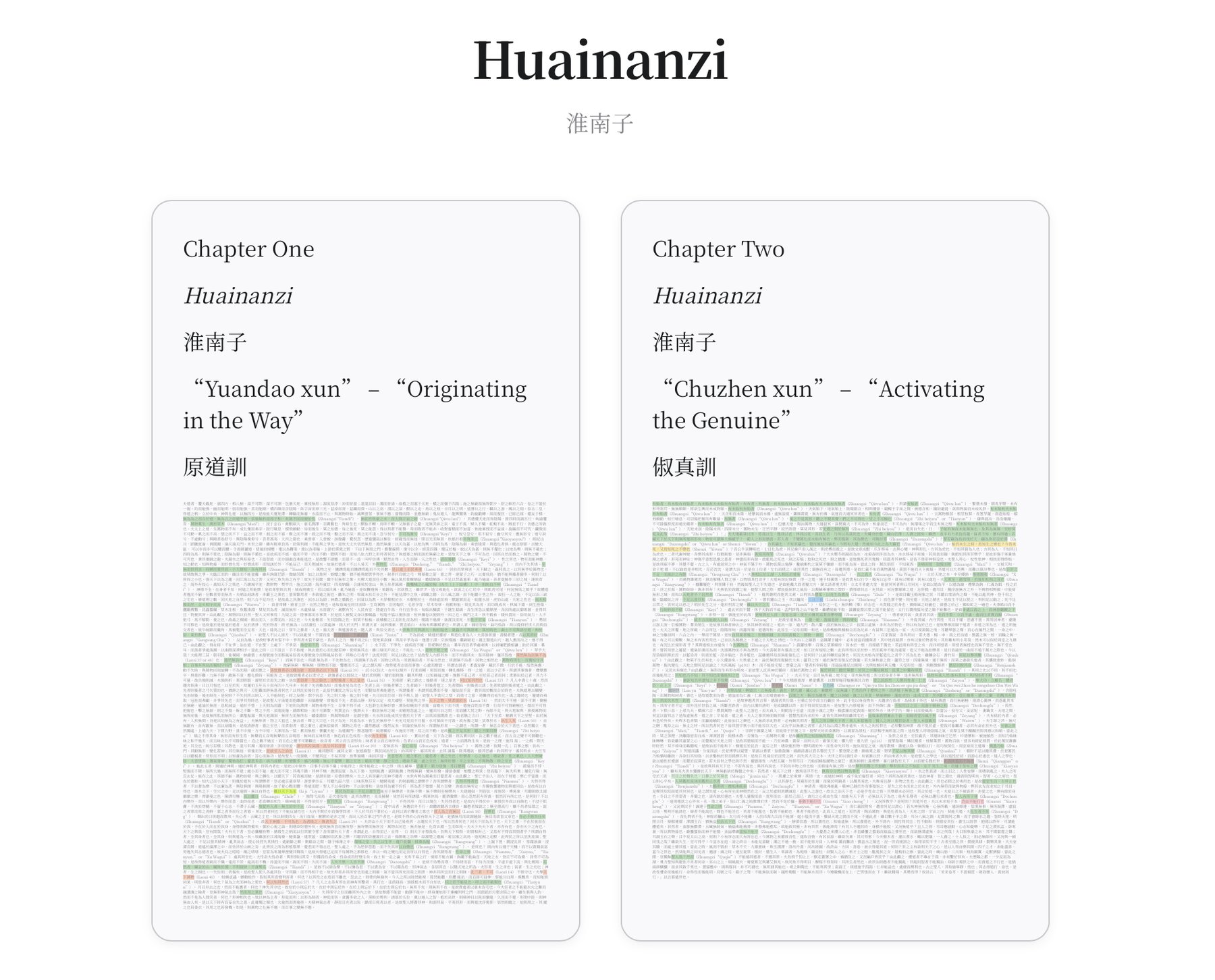
Screenshots from the hyperlinked edition: the main surface and the annotated text.
How it was made
- Trace parallels: ctext.org · Text Alignments
- Cross-check against the curated list
- Remove false positives by hand
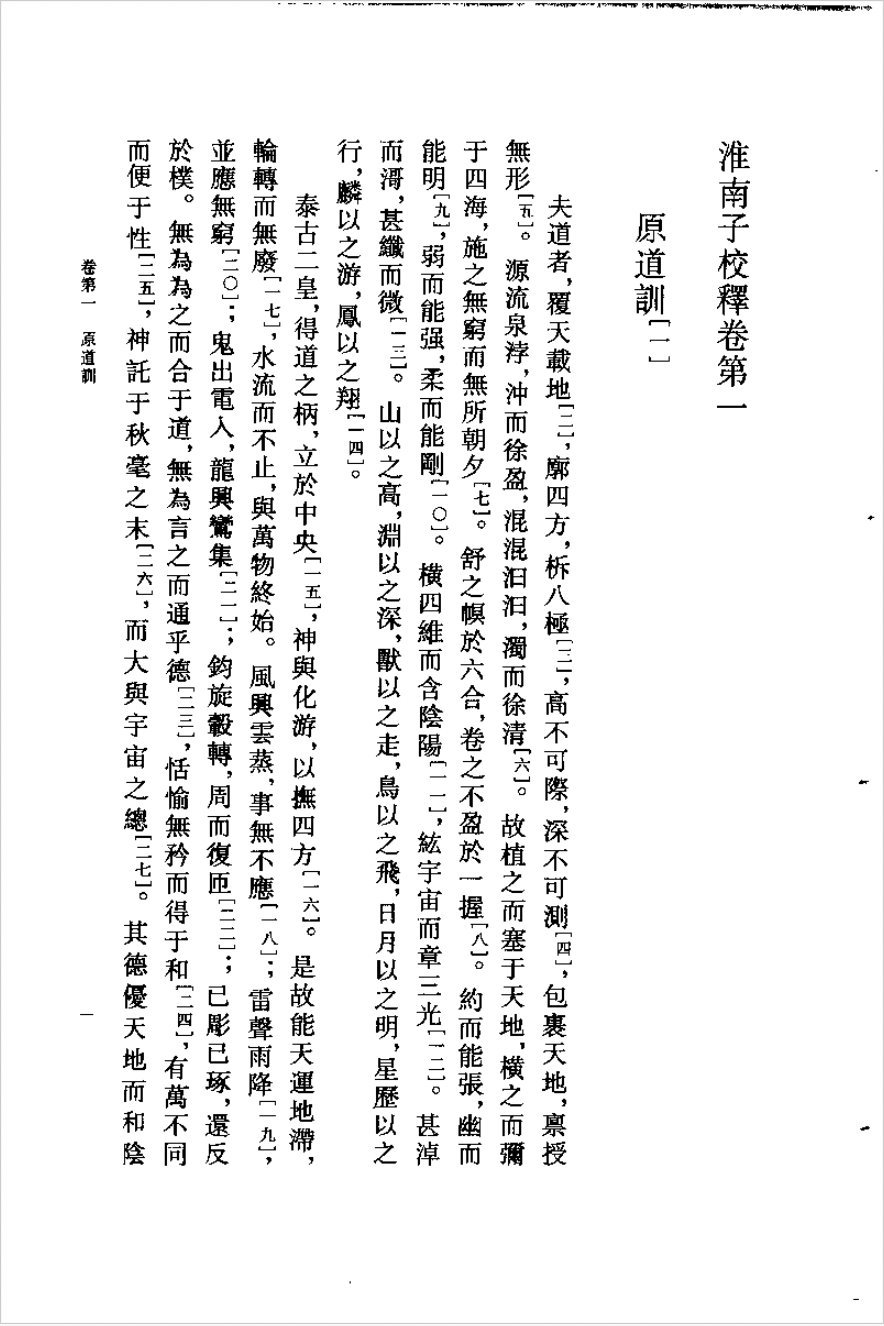
- OCR and mark up two critical editions
Textual parallels were traced with two open tools, ctext.org and Text Alignments, then read against a manually curated list and checked for false positives. Two critical Chinese editions were OCR’d, marked up and aligned.
The aim
To give scholars worldwide a tool for exploring the Huainanzi’s intertextuality, and to substantiate the argument that Liu An and his courtiers used intertextuality deliberately — writing as weaving.
What the edition does
A researcher can search the whole work and its parallels, zoom from a bird’s-eye view of the chapters down to a single line, annotate the text and export or import those annotations, and open a pop-up of every candidate parallel behind a colour-coded passage.
What was difficult
Tracing and double-checking every parallel is slow — the first two chapters took months.
Future workflows will be scaffolded so the computing side never idles.
It is not always clear which pre-Han text a passage refers to.
Every candidate parallel is offered in a pop-up, rather than one answer being imposed.
On the road
The project was presented at its early stage in the “A Taste of Digital Scholarship” talk series, part of the Library’s Digital Scholarship Roadshow, on 17 March 2026.
What comes next
Undergraduate research courses continue, a GRF application is planned for autumn 2026, and the aim is a hyperlinked edition of the complete Huainanzi by the end of 2029 — with a reusable blueprint for hyperlinked editions of early Chinese writing in general.
Who made it
Principal Investigator
- Prof. Dr. Tobias Benedikt ZÜRN — Division of Humanities
Student assistants
- Lakshya AGARWAL
- Oak Soe OO
- Xinwen ZHANG
Project support
- Dr. Steve MA — Division of Humanities
- Yifan WANG — Library
Selected sources
- Le Blanc, Charles. Huai-nan Tzu: Philosophical Synthesis in Early Han Thought. Hong Kong: Hong Kong University Press, 1985.
- Zürn, Tobias Benedikt. “The Han Imaginaire of Writing as Weaving: Intertextuality and the Huainanzi’s Self-Fashioning as an Embodiment of the Way.” Journal of Asian Studies 79.2 (2020): 367–402.
- Zürn, Tobias Benedikt. Forthcoming. Text/Bodies: The Huainanzi’s Self-Fashioning as a Powerful Scripture of the Way. Albany: SUNY Press.
- Text-reuse tools: ctext.org (Donald Sturgeon) · Text Alignments (Jeffrey Tharsen).