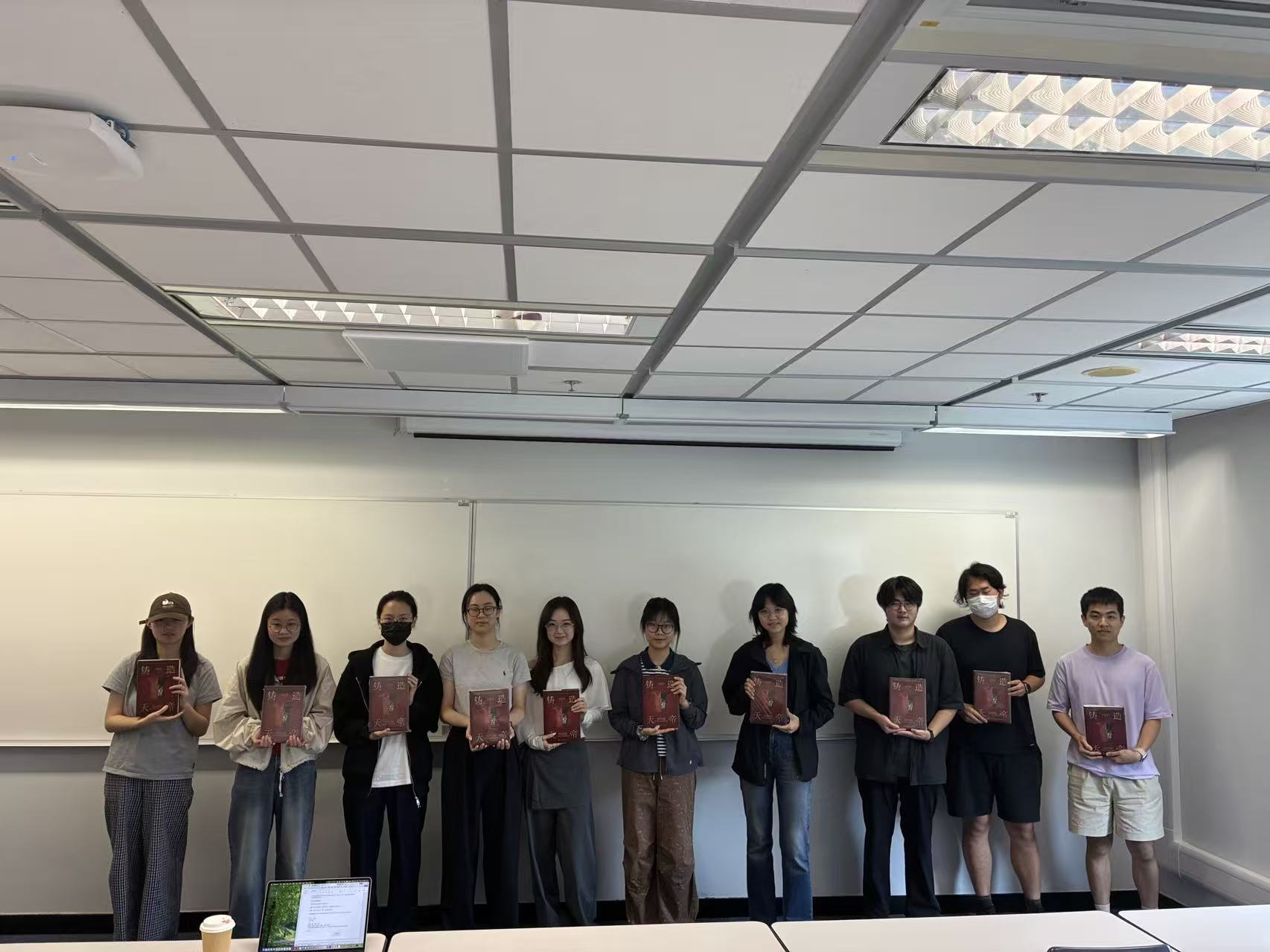
The Hong Kong University of Science and Technology (HKUST) invited Xin Deyong, Chair Professor in the Department of History at Peking University, to present his new book Casting the Heavenly Emperor (Zhuzao Tiandi) at a lecture on campus. The lecture was livestreamed with support from Prophet Books, China’s largest online book brand, and drew nearly 3,000 views. Students who attended received copies of the book.
A leading name in the field comes to lecture
Xin is a leading authority on Chinese historical geography, bibliography and textual criticism, and chairs the historical geography committee of the Chinese Historical Association. He was born in August 1959 and studied geography before turning to history, taking a bachelor’s degree at Harbin Normal University in 1982 and master’s and doctoral degrees in history at Shaanxi Normal University in 1984 and 1988. He taught at Shaanxi Normal University, worked as a research fellow at the Institute of History of the Chinese Academy of Social Sciences, and joined Peking University in 2004.
His books include An Examination of the Two Capitals of the Sui and Tang, Ancient Transport and Geographical Documents, The Space of History and the History of Space and Studies of Qin and Han Administrative Regions and Boundary Geography. They are read both for their scholarship and for their readability, by specialists and by general readers of history.
Reading the bronze
The new book examines the ornament of ancient bronze ritual vessels. It begins with the Song dynasty antiquarian catalogue Kaogutu and reconsiders the established reading of the taotie motif. Xin separates the imagery into its components, among them the taotie, the divine tiger, the great dragon, the boar’s head and the sacrificial ox’s head, and traces the creatures behind them, including the crocodile, the pig, the tiger, the phoenix and the snake.
Read alongside the astronomy and cosmology of high antiquity, the patterns carry a theology: belief in a heavenly emperor, an order of heaven and earth, the working of yin and yang and the place of the stars. The book follows these ideas through the shapes and signs on the vessels, and traces the imagery of the contending dragon and tiger, the harmony of dragon and phoenix, and the union of turtle and snake. It steps outside established textual criticism, linking remains from several regions to offer a new reading of early ornament.
Academic reach across borders
The livestream recorded nearly 3,000 views, and coverage of the lecture received more than 13,000 likes. Both reflect the standing of HKUST’s humanities and digital humanities work in the academic world, and the effort the Division of Humanities and the Humanities and Digital Technologies Research Platform put into improving the learning experience.
HKUST’s Humanities and Digital Technologies Platform runs more public lectures, workshops and training than any other humanities platform in Hong Kong, bringing scholars from the mainland and overseas to the University throughout the year. Its work has received a series of awards, including selection as a National Exemplary Case of Language Technology Innovation Empowering Key Sectors in 2026.