

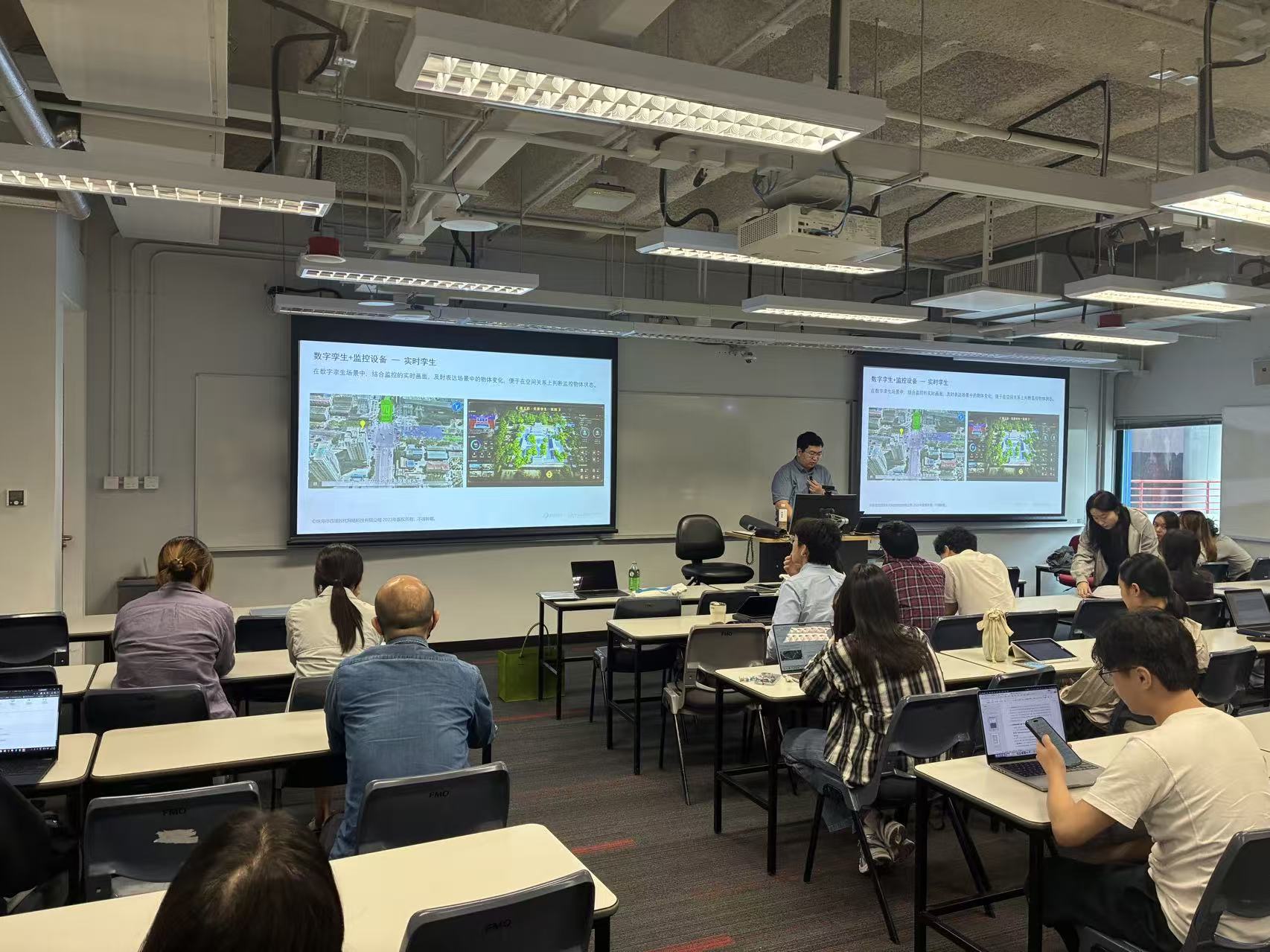
The Hong Kong University of Science and Technology (HKUST) held a public lecture on 7 October. Cui Yan, a deputy to the National People’s Congress and a Chair Professor at Wuyi University, spoke on 3D spatial vision technology and its cultural applications. More than 70 staff and students attended.
Cui is a Chair Professor in Artificial Intelligence and Director of the China-Germany Artificial Intelligence Institute at Wuyi University. He founded 4DAGE, a leading company in 3D digitisation, and heads the Guangdong Provincial Engineering Research Centre for 3D Computer Vision. He also serves as a cybersecurity and informatisation expert for the Counselors’ Office of the State Council, as a member of the editorial committee for the National Cultural Big Data System Construction Standards, and as a member of the smart city working committee of the Chinese Society for Geodesy, Photogrammetry and Cartography.
He was selected for the fourth batch of national science and technology entrepreneurship leading talents by the Organization Department of the Communist Party of China Central Committee, and named a science and technology innovation and entrepreneurship talent under the Ministry of Science and Technology’s Innovation Talent Promotion Plan. His honours include the 10th China Youth Entrepreneurship Award in 2019, the Top 100 Postdoctoral Innovators of Guangdong Province in 2020 and the 24th Guangdong Youth May Fourth Medal in 2022. He served on the expert committee for the 2017 white paper on the development of new generation artificial intelligence, reviews for leading international conferences and journals, sits on the board of GraphicsVision.AI and is an associate editor of AI Perspectives.
The lecture set out the workflow for digitising cultural heritage. The first step is capture, where the limits are usually light, accessibility and the immovability of the objects. Photographs and scans then rebuild a geometric model, which in turn supports museum display, archaeological research and public presentation. Cui also described how 3D capture and modelling are used in smart cities, and his work on drafting the national cultural big data standards.
In recent years HKUST has opened a series of courses in artificial intelligence and digital humanities that track industry practice, and speakers from industry and cultural institutions visit the University throughout the year. This lecture drew on a digital humanities course newly developed by Dr Ma Haonan; the course has been well received by students and ranks highly in independent third-party course reviews.
After the lecture, staff of the Division of Humanities continued to discuss heritage conservation with the speaker. Taking Tai O as an example, participants noted that heritage of this kind, at once historically valuable and fragile, faces an urgent need to be recorded and passed on. The 3D recording and digital display techniques described in the lecture offer a way to preserve such places, keeping a record of buildings and landscape as well as knowledge of community life, for researchers and for the public. HKUST will keep working closely with industry to support the conservation of this kind of heritage.