
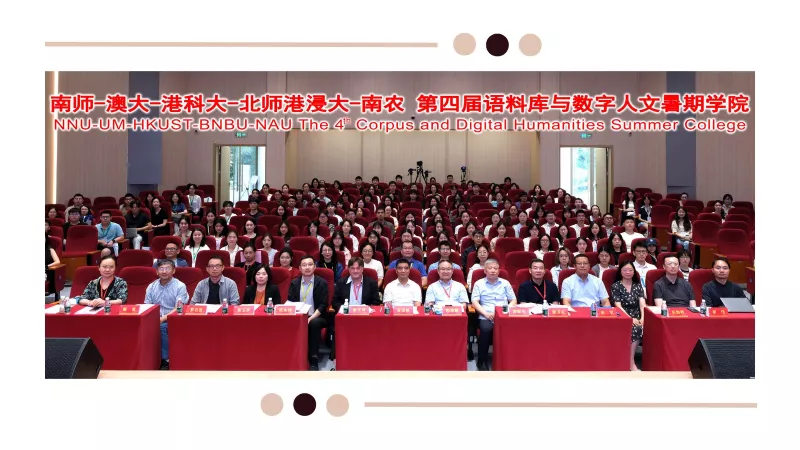
The Hong Kong University of Science and Technology (HKUST), in collaboration with Nanjing Normal University, the University of Macau, Beijing Normal-Hong Kong Baptist University, and Nanjing Agricultural University, successfully organized the 4th Summer College of Corpora and Digital Humanities (CDH Summer 2026) in Nanjing. The opening ceremony included an address by Prof. LI Ping, Dean of the School of Humanities and Social Science and Chair Professor of the Division of Social Science, and a keynote lecture by Prof. Cameron CAMPBELL, Chair Professor of the Division of Social Science, delivered to both in-person participants and thousands of online viewers.
Prof. Li Ping highlighted the unprecedented opportunities that artificial intelligence presents for the humanities and social sciences. Citing the recent Dean’s Forum on “Challenges and Opportunities for Humanities and Social Sciences in the Era of AI,” successfully organized by the School, Professor Li emphasized the growing importance of mastering digital humanities methodologies and AI technologies. He encouraged all participants to embrace new technologies with an open mind, examine them with a critical perspective, and engage them with humanistic insight. He also extended a warm welcome to scholars and experts from around the world to visit HKUST.
Prof. Cameron CAMPBELL reflected on over four decades of experience in quantitative historical analysis and digital humanities accumulated by the Lee-Campbell Research Group, which includes Emeritus Prof. James LEE and Prof. CAMPBELL, and other members from international partners. The team has contributed numerous well-known datasets based on primary sources to the academic community. He urged participants to employ computational humanities tools with rigor and a critical approach.
The opening ceremony also showcased a series of cutting-edge research outcomes in digital humanities. Prof. Michael Yan Hon CHUNG, Assistant Professor of the Division of Humanities, unveiled a newly trained Optical Character Recognition model for the Manchu script. This work not only demonstrates the latest AI achievements of HKUST’s digital humanities community but also serves as a model for research on low-resource and endangered languages.