
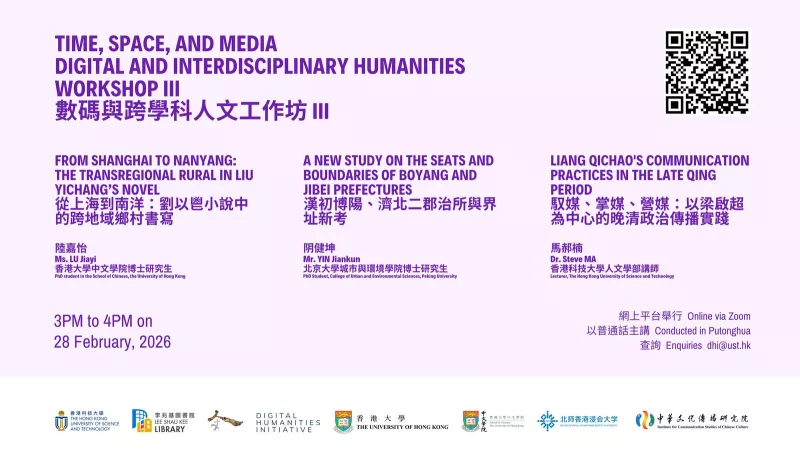
Lu Jiayi of the University of Hong Kong re-examines the rarely discussed rural writing in Liu Yichang’s fiction, tracing it from 1930s Shanghai to the Nanyang novels of the 1950s and 1960s.
From Shanghai to Nanyang: The Transregional Rural in Liu Yichang’s Novel
PhD student in the School of Chinese, the University of Hong Kong
This paper reexamines the understudied rural depictions in the works of Liu Yichang (1918–2018). Renowned for his urban settings and mastery of New Sensation School techniques, Liu’s 1930s rural novels from Shanghai reveal an alternative stylistic trajectory similar to 1930s-style Chinese realist rural narratives. Following this early period, rural themes disappeared from Liu’s works, only to reemerge in the 1950s–1960s in Liu’s Nanyang novels. This article examines how Liu balanced the commercial and ideological pressures of Cold War-era U. S. -sponsored publishing networks with his artistic ambitions.
A New Study on the Seats and Boundaries of Boyang and Jibei Prefectures in the Early Han Dynasty
PhD Student, College of Urban and Environmental Sciences, Peking University
In the sixth year of Emperor Gaozu of the Han Dynasty, the former Qin Jibei Prefecture, previously Tian An’s Jibei Kingdom, was divided, establishing Boyang Prefecture and Jibei Prefecture. Based on clay seals such as the “Seal of the Neishi of Lü” and the “Seal of the Chief Palace Officer of Lü” unearthed from the Han-period Luozhuang tomb in Shandong, as well as the record in The Table of Marquises of Royal Blood in the Book of Han, that the Boyang Marquis enfeoffed by Emperor Wu was located within Jinan Prefecture, it is evident that Boyang was situated in present-day Zhangqiu, Shandong. This was not the same location as the ancient Bo County, whose former territory falls within present-day Tai’an.
Between New Media and New Intellectuals: Liang Qichao’s Communication Practices in the Late Qing Period
Lecturer, The Hong Kong University of Science and Technology
The engagement of reform-minded scholars such as Kang Youwei and Liang Qichao with new media including newspapers and journals can be roughly divided into four stages. In the first stage, the problems encountered by Kang and Liang were mainly relatively superficial. However, with their success in publications such as Zhongwai Jiwen and Qiangxue Bao, their media practices entered a second stage, which focused on the struggle for control over newspapers and publishing power. Through their efforts to compete for discursive authority in Shiwubao and Qingyi Bao, Kang, Liang, and others gradually developed a set of methods to control newspapers. Finally, through Liang Qichao’s innovation in Xinmin Congbao, Liang ultimately explored a way to create the modern political media.